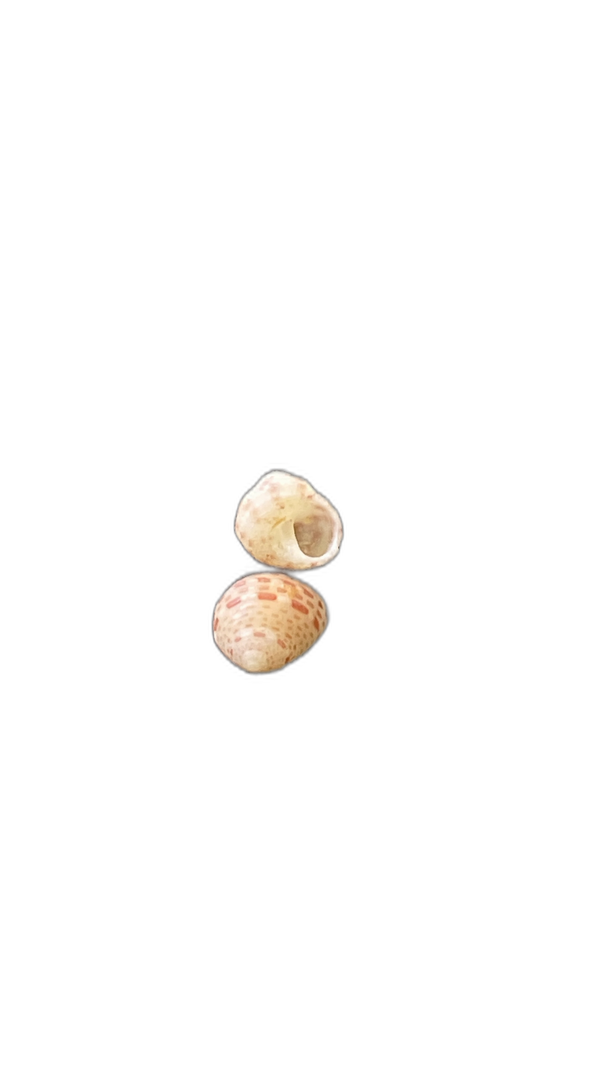
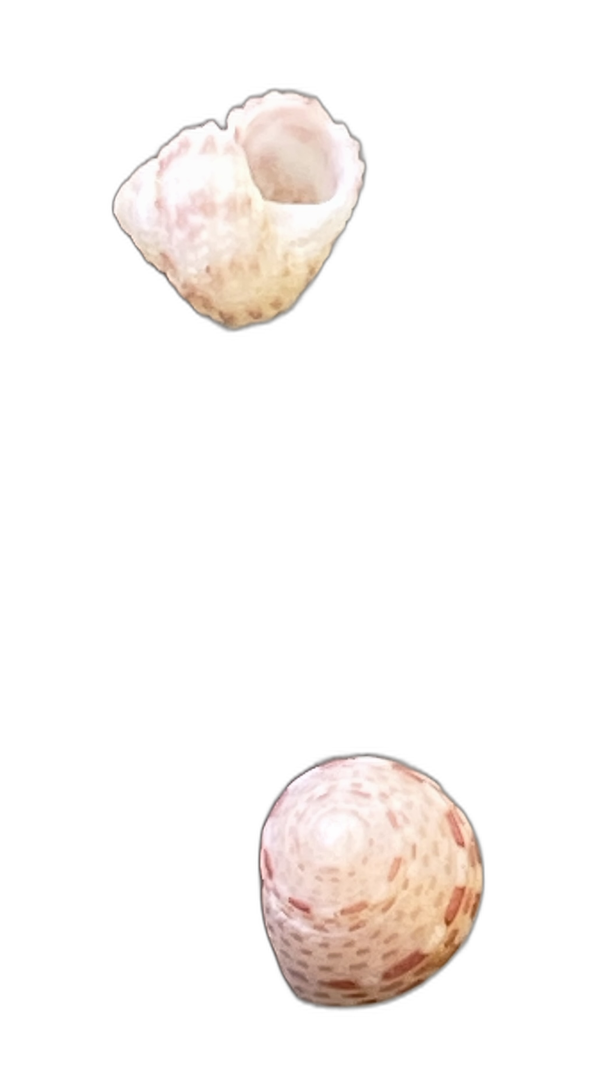
Two momi shells. Each smaller than a fingernail.
The top view reveals the spire — a tight spiral of speckled pigment, coral-brown dashes on a bone-white field. No two momi shells carry the same pattern. Collectors who have sorted thousands will tell you that matching even a pair requires patience measured in weeks, not hours.
The aperture view shows the architecture — the opening through which the animal once extended, now a smooth porcelain cup. This is the surface that sits against skin when strung into a lei. The wearer feels smoothness. The viewer sees pattern. The shell carries both.
About Momi
Momi (Theodoxus vespertinus) are among the smallest shells used in Hawaiian lei-making. Found in shallow reef flats around Ni’ihau and the Na Pali coast, they are collected by hand — one at a time, often while free-diving in surge.
A single momi lei requires 800 to 1,200 shells. Grading takes longer than collecting. The maker holds each shell to the light, evaluates the density and distribution of the speckled pattern, and decides: keep or return.
- Species: Momi (Theodoxus vespertinus)
- Size: 4–7mm diameter
- Collection: Hand-picked from reef flats
- Grading time: 2–3x collection time
- Shells per lei: 800–1,200
- Catalog: BSS-VP-003