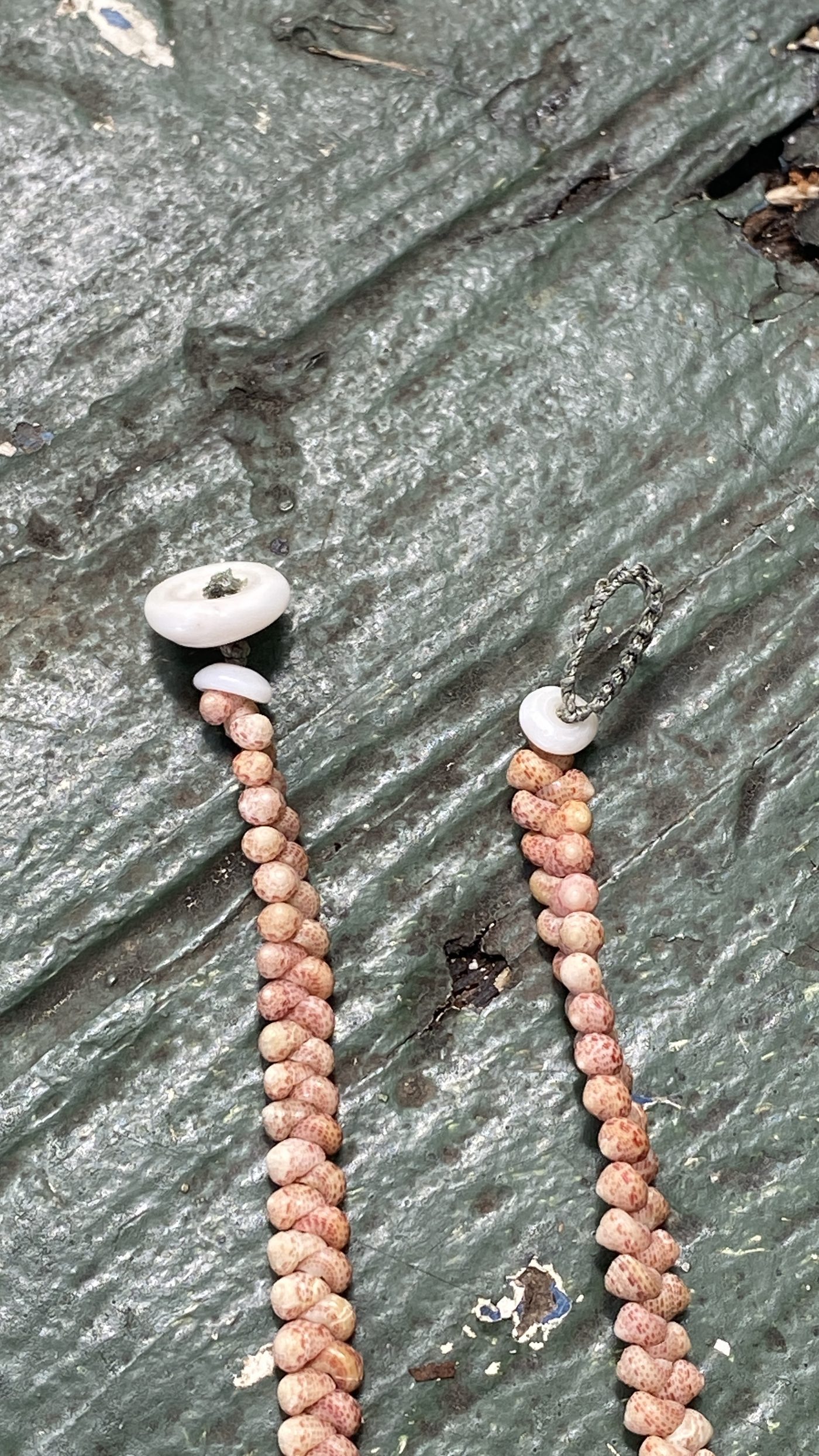
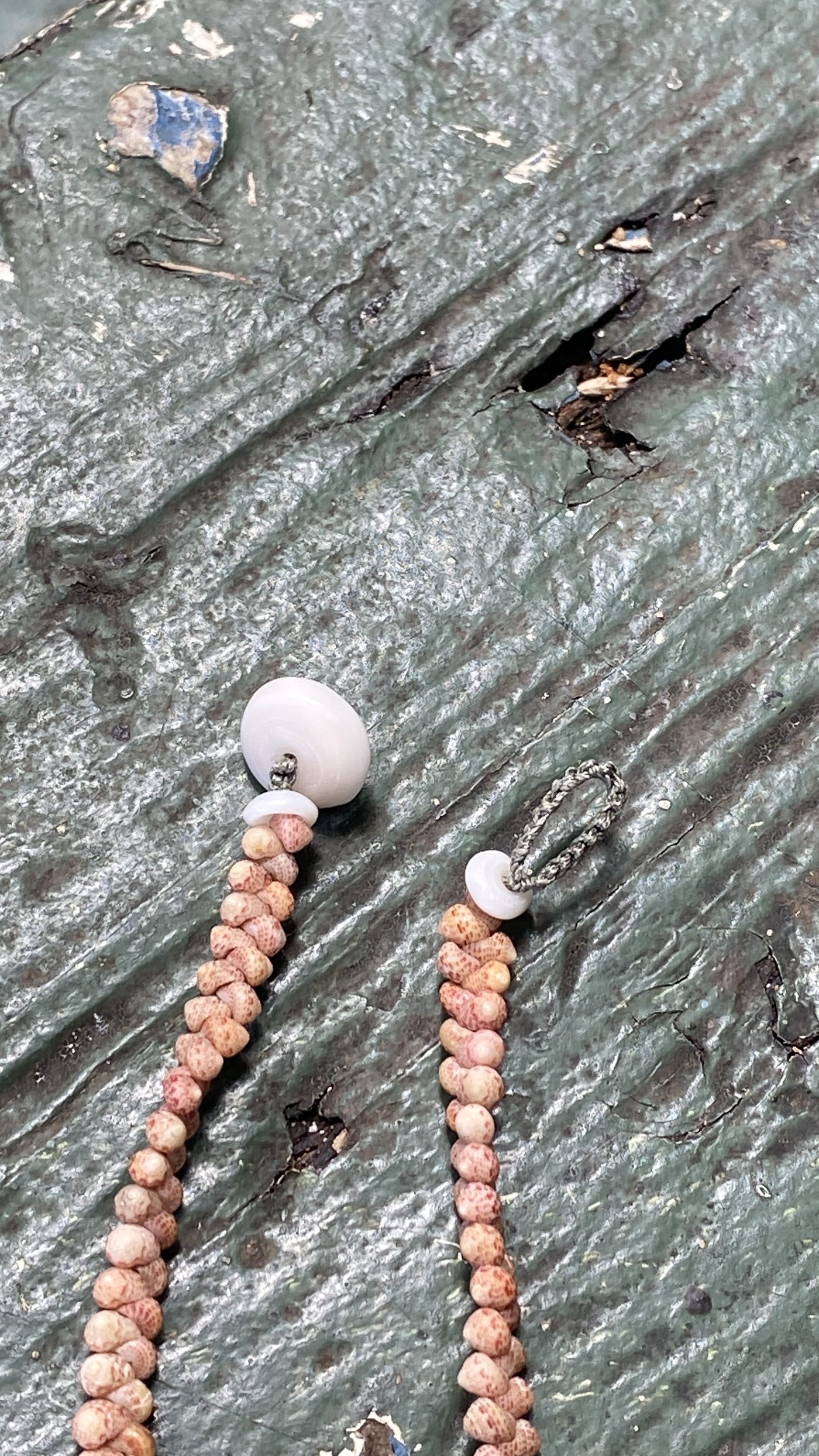
The clasp is where the necklace becomes a circle.
Everything before this moment is linear — a strand, a rope, a sequence of shells laid end to end like words in a sentence. The clasp is the period. The clasp is where the sentence bends back on itself and becomes a loop, and a loop is the oldest symbol we have for things that do not end.
Study 1: The Puka Button
A single puka shell, selected for its symmetry and drilled through the center — not by the ocean this time, but by the maker, with a hand drill and the kind of precision that makes watchmakers nervous. The button sits at one end of the strand. It is white. It is smooth. It is the size of a shirt button and twice as strong.
The kahelelani shells approach it from both sides, their spotted bodies narrowing toward the terminus the way a river narrows toward a falls. The transition is abrupt — from the warm, speckled chaos of the kahelelani to the cool, clean geometry of the puka — and the abruptness is intentional. The maker does not believe in gradual transitions at the clasp. The clasp is a boundary. Boundaries should be clear.
Study 2: The Braided Loop
On the opposite end: a loop of braided monofilament, tight as a bowline, small enough to grip the puka button and large enough to release it when asked. The braid is three-strand — over, under, over — and it terminates in a wrap that is invisible from more than six inches away, which is to say it is invisible in practice, because no one examines a clasp from less than six inches away unless they are a maker or a thief.
The loop has no metal. No spring. No mechanism. It holds because the braid holds, and the braid holds because the maker braided it the way the maker braids everything: slowly, tightly, with a tension that is consistent across every centimeter because inconsistent tension is the difference between a clasp that lasts and a clasp that fails at a dinner party.
What the Clasp Means
Every necklace is a question. The clasp is the answer. The question is: will this hold? And the answer — in this case, in every case from this studio — is the same three words that form the foundation of every transaction between maker and wearer, between art and trust, between the thing that was made and the person who will carry it:
It will hold.